Introduction to Data Structure and Algorithm
Why Many Beginners Want to Learn DSA from Scratch
Today, many students want to become software developers, web developers, game developers, or app creators. Because of this, they start searching for ways to learn DSA from scratch. DSA stands for Data Structure and Algorithm. These are two very important topics in computer science. They help programmers write faster, smarter, and better code.
Many beginners think DSA is very difficult. They become scared after hearing words like arrays, stacks, trees, graphs, and algorithms. But the truth is very different. DSA becomes easy when you learn it slowly with simple examples and regular practice. You do not need to be a genius to understand it. You only need patience and consistency.
This guide is written in very simple language so that even a beginner or a school student can understand it comfortably. The goal of this article is to help you learn DSA from scratch without confusion or fear.
What Does DSA Mean?
Data Structure and Algorithm are connected topics. A data structure is a way to store data properly inside a computer. An algorithm is a step-by-step process used to solve a problem.
Think about your school bag. Your books, pens, and notebooks are stored inside the bag in an organized way. This is similar to a data structure. Now think about the way you arrange those books. Maybe you keep important books in the front and less important books at the back. That process is like an algorithm.
This simple example helps beginners understand why DSA is important. Computers also need organized data and smart methods to solve problems quickly.
Why Students Should Learn DSA from Scratch
DSA Improves Problem-Solving Skills
One of the biggest reasons to learn DSA from scratch is problem solving. DSA teaches you how to think logically. Instead of guessing solutions, you learn how to solve problems step by step.
For example, imagine you want to find a name inside a very large list of students. If the list contains thousands of names, searching randomly will waste time. DSA teaches better ways to search quickly and efficiently.
This logical thinking helps not only in coding but also in daily life. Students become better at analyzing situations and finding smart solutions.
DSA Helps in Coding Interviews
Many companies ask DSA questions during interviews. Big companies want programmers who can solve problems efficiently. Because of this, students who understand DSA usually perform better in technical interviews.
If you want a career in programming or software development, learning DSA is very important. Many interview questions are based on arrays, linked lists, sorting, searching, stacks, queues, trees, and graphs.
This is why thousands of students start learning DSA every year.
DSA Makes Programs Faster
Programs should not only work correctly but also work quickly. Imagine opening an app that takes five minutes to load. Most people would uninstall it immediately.
DSA helps developers create fast programs. Good algorithms reduce time and improve performance. This is why companies care so much about DSA.
When you learn DSA from scratch, you begin understanding how to write smarter and cleaner code.
Understanding Data Structures
What is a Data Structure?
A data structure is a method used to organize and store data inside a computer. Proper organization makes data easier to access, manage, and update.
Imagine a library. If books are thrown everywhere randomly, finding a single book becomes difficult. But if books are arranged properly by category, finding them becomes easy.
Data structures work in a similar way. They organize information so computers can use it efficiently.
Why Data Structures Matter
Data structures are used everywhere in technology. Social media apps, games, websites, navigation systems, and online shopping platforms all use data structures.
Without proper data structures, modern applications would become very slow and difficult to manage.
Students who learn DSA from scratch slowly understand how important organized data really is.
Learning Arrays
What is an Array?
An array is one of the easiest data structures. It stores multiple values inside a single variable.
For example:
[10, 20, 30, 40]This simple structure stores four numbers together.
You can think about arrays like seats in a classroom. Every seat has a position number. Similarly, every value inside an array has an index position.
Arrays are usually the first topic students learn in DSA because they are simple and beginner-friendly.
Real-Life Example of Arrays
Imagine a row of lockers in a school. Every locker has a number. If you know the locker number, you can quickly access it.
Arrays work in the same way. Every item has a position, making data easy to access.
This simplicity makes arrays very important when students start to learn DSA from scratch.
Understanding Linked Lists
What is a Linked List?
A linked list is another data structure used to store data. Unlike arrays, linked lists connect data using links.
Every item inside a linked list points to the next item. This creates a chain-like structure.
Think about a treasure hunt. One clue leads to another clue. Linked lists work in a similar way.
Why Linked Lists Are Useful
Linked lists are useful because their size can grow easily. Arrays usually have fixed sizes, but linked lists can expand whenever needed.
Many real-world applications use linked lists because they allow flexible memory usage.
When beginners learn DSA from scratch, linked lists help them understand dynamic data storage.
Understanding Stack
What is a Stack?
A stack follows a simple rule called Last In First Out. This means the last item added is removed first.
Imagine a stack of plates in a kitchen. The plate placed last is removed first. This is exactly how stacks work.
Stacks are very common in programming and software development.
Real-Life Uses of Stack
Stacks are used in many applications. The undo feature in text editors uses stacks. Browser history also works using stacks.
For example, when you press the back button in a browser, stacks help move backward through visited pages.
Students usually enjoy learning stacks because they are easy to imagine in daily life.
Understanding Queue
What is a Queue?
A queue follows a different rule called First In First Out. The first item added is removed first.
Think about people waiting in a ticket line. The person who arrives first gets the ticket first.
Queues are used in many real-world systems.
Real-Life Uses of Queue
Queues are used in printer systems, online booking websites, and customer support systems.
For example, when multiple people send files to a printer, the printer handles them one by one in order.
When students learn DSA from scratch, queues help them understand how organized systems work.
Understanding Trees
What is a Tree Data Structure?
A tree is a hierarchical data structure. It looks similar to branches of a real tree.
Trees contain parent and child nodes connected together.
One common real-life example is the folder system inside computers. A main folder can contain many smaller folders inside it.
Why Trees Are Important
Trees are used in many technologies. Search engines, mobile apps, file systems, and gaming systems use trees for better organization.
Trees help computers search and manage data quickly.
This is why trees become an important topic when students continue learning DSA.
Understanding Graphs
What is a Graph?
Graphs connect multiple points together. These points are called nodes, and the connections are called edges.
A simple example is Google Maps. Cities are connected using roads. Graphs help find the shortest and fastest routes.
Real-Life Uses of Graphs
Social media platforms use graphs to connect people. Navigation apps use graphs to calculate routes.
Graphs are one of the most powerful concepts in DSA and are widely used in modern applications.
Understanding Algorithms
What is an Algorithm?
An algorithm is a step-by-step process used to solve a problem.
For example, making tea follows a sequence of steps. First, water is boiled. Then tea powder is added. After that, milk and sugar are added.
This sequence is an algorithm because it follows proper steps.
Why Algorithms Matter
Algorithms are important because they improve speed and efficiency. A bad algorithm can make programs slow, while a good algorithm makes them faster.
This is why programmers focus heavily on algorithms.
Students who learn DSA from scratch slowly understand how algorithms control program performance.
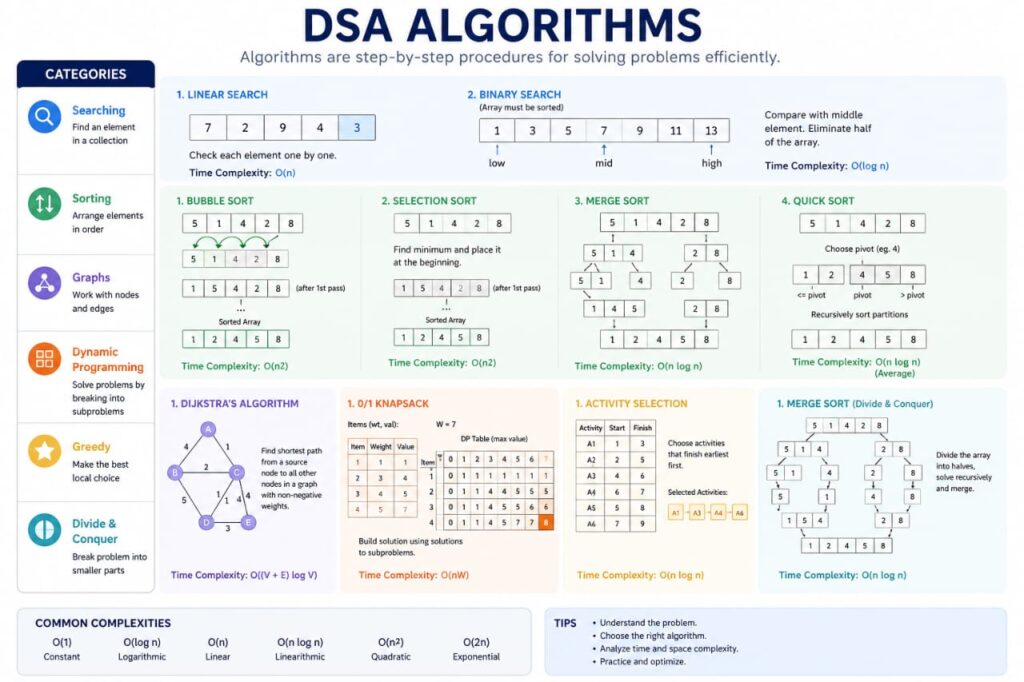
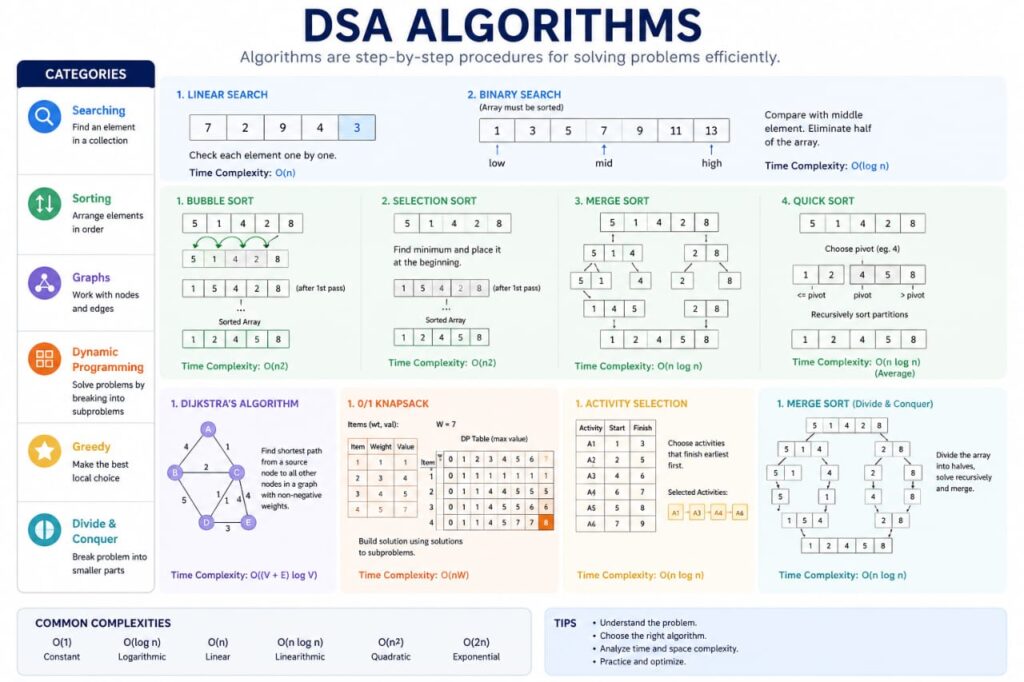
Searching Algorithms
What is Searching?
Searching means finding data from a collection.
For example, finding a student’s name in a school database is a searching operation.
Linear Search
Linear search checks data one by one until the correct value is found.
It is easy to understand but slower for very large data.
Binary Search
Binary search is much faster. It works only on sorted data.
Instead of checking every value, it repeatedly divides the data into smaller parts.
Binary search is an important topic for beginners learning DSA.
Sorting Algorithms
What is Sorting?
Sorting means arranging data in a proper order.
For example, numbers can be arranged from smallest to largest.
Sorting is used everywhere, including shopping websites, search engines, and ranking systems.
Bubble Sort
Bubble sort compares nearby values and swaps them if needed.
It is simple and easy for beginners.
Merge Sort
Merge sort divides data into smaller parts and then combines them again in sorted order.
It is much faster than simple sorting methods.
Time Complexity
What is Time Complexity?
Time complexity measures how fast an algorithm works.
Some algorithms solve problems quickly, while others take more time.
Programmers use Big O notation to measure performance.
Why Time Complexity Matters
Fast programs improve user experience. Nobody likes slow applications.
When you learn DSA from scratch, understanding time complexity helps you write better and faster programs.
Best Programming Languages for DSA
Python for Beginners
Python is one of the best languages for beginners because it is simple and easy to read.
Many students start DSA using Python.
Java for Interviews
Java is popular in coding interviews and software development.
It is widely used in companies.
C++ for Competitive Programming
C++ is very fast and powerful. Many competitive programmers prefer C++ because of its speed.
Best Websites to Practice DSA
Practice Coding Daily
Practice is very important in DSA. Watching tutorials alone is not enough.
You can practice on these websites:
These websites provide beginner-friendly coding problems and tutorials.
Final Thoughts
If you truly want to become a programmer, then start today and learn DSA from scratch. Do not worry if topics look difficult in the beginning. Every expert programmer once started as a beginner.
The key to success is daily practice and patience. Learn slowly, understand concepts clearly, and solve coding problems regularly.
DSA is not only about coding. It teaches logical thinking, problem solving, and smart decision making.
So continue learning, keep practicing, and enjoy your journey into the world of programming.